How long Can You Tread Water? Prepare To Be Prepared by Knowing...
By Deborah Maynard, Lt Col, CAP USAF and TC4 Member
Article #2 in the Great Shake Out Series sponsored by Tillamook County Citizen Corps Council - TC4
How do we prepare for surviving an earthquake and a tsunami? What happens after the initial splash? It helps to know what a tsunami is, and what it can do! Everyone is familiar with earthquakes. The ground moves; so does everything else. But what happens with a tsunami?
How can we plan to survive? How long can you tread water (Bill Cosby said that in one of his comedy routines about Noah and the Ark.)? The first step is to get educated. Earthquakes and tsunamis go hand in hand for coastal areas and regions with huge lakes. In this second article in the series about the Great Shake Out we will showcase tsunamis.
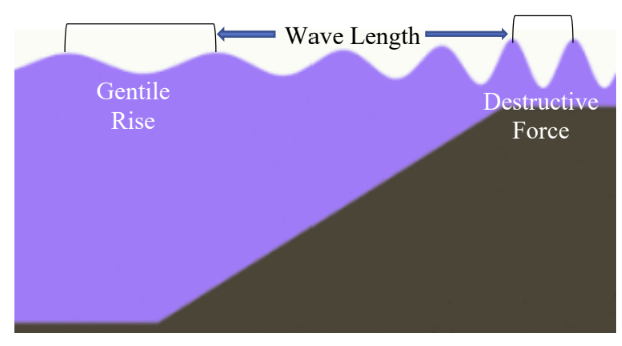
Here we go... what is a tsunami? We used to call them tidal waves, but they have nothing to do with tides! TSUNAMI is a Japanese word for “harbor wave”. But it is not just one big wave that comes in and goes out; it is a series of waves caused by a huge displacement of water in the ocean or a big lake. Unlike normal waves, tsunamis are not generated by wind or tides. Unusual geological events have the potential to create a tsunami: earthquakes, erupting volcanoes, explosions above and beneath the water, calving glaciers, underwater landslides, meteorite impact, etc. A tsunami wave length (measurement from the tops of each wave) is much longer than a regular wave, sometimes measuring miles between crests in the open ocean. At sea a tsunami may appear as a large swell, or rise in the water, but closer to shore a tsunami may resemble an approaching wall of water which compresses and builds as it rushes over shallowing lands.
When the wave enters shallow water, it slows down and builds, cresting as an incredibly destructive surge. Tsunami, or tidal wave, is a misnomer since most tsunamis do not generate breaking waves like you see at the shore. Rather they resemble a rapidly rising tide which continues far past the usual tidal limit.
Additionally, when tsunamis come in and go out several times the surging water causes enormous destruction to the geography and any structures or marine transport that may be in the “flushing” zone. Surges, may come and go within minutes or, sometimes, there are hours between the cycles. Generally, coastal areas and waterways affected by regular tide change are where the most damage from a tsunami will occur. However, entire ocean basins can be affected by enormous earthquakes and tsunamis. The 2004 Indian Ocean tsunami was a perfect example of the size and breadth of impact a huge tsunami can have. Some 230,000 people were killed or missing across fourteen countries around the Indian Ocean and trillions of dollars in damage occurred during that event. That devastating tsunami was the result of a 9.2-9.3 magnitude earthquake off the coast of Aceh on Sumatra. The mega-thrust earthquake could be felt as far away as Alaska and spawned a tsunami with an approximate height of one-hundred feet. The Indian Ocean tsunami was due to a fault rupture extending about one thousand miles.
Our own Cascadia Subduction Zone extends about 650 miles and is located about 70 to 100 miles off the Pacific coastline. If our fault ruptures, it may generate a comparable tsunami! So, are there drawbacks to living on our beautiful coast close to the Cascadia Subduction Zone? Of course, but definitely not the kind of drawback you might be thinking about while reading this article! The “drawback” involved in a tsunami is actually the name of a hydraulic effect of the wave prior to moving inland. It’s even officially called a “drawback”. As the wave pulls back preparing to surge, it may expose shore that has never been seen before. This is NOT the time to run down and pick up sand dollars, shells, or watch the water go out! It is simply the interim period before the surge of water. It is not the time to grab a surfboard and head out! It’s time to get to an emergency assembly area or seek higher ground.
So where do I go? What is an emergency assembly area? Where are the emergency assembly points? How will I get there? All good questions. And all the information is readily available. For more information, go to:
Tillamook County Great Oregon ShakeOut:
Great Oregon ShakeOut! - 10/15/2026 at 10:15 am
https://www.shakeout.org/oregon/
Maps with Evacuation Zones :
https://nvs.nanoos.org/TsunamiEvac
Prepare to be prepared by knowing. Knowledge is power! Join the Great Shake Out exercise to Prepare, Plan and Practice! October 15th at 10:15 am!